Showing posts with label Honey. Show all posts

Wednesday, July 29, 2026

Harvesting Honey at Heifer Ranch


Local beekeeping associations are a community of friends who share a common interest These associations also provide training and experience in the art and science of beekeeping. The Ozark Foothills Beekeepers Association is conducting training in practical beekeeping techniques. Following their beginning beekeeping classes, demonstrations at the bee yard of one of the group’s sponsors, A Bee’s Closet, and presentations at the association’s regular meetings, the association conducted a hands-on training session on harvesting and handling honey at the honey house and bee yard of Heifer Ranch in Perryville, Arkansas. One of the Ozark Foothills’ experienced beekeepers, demonstrated methods of handling and marketing honey.

Everyone got a chance to actually handle the honey. Starting with frames of honey that had been previously taken from the hives, beekeepers removed the beeswax cappings to expose the honey using cold serrated knives. Next, frames were spun in extractors to remove the honey. The group got to use both tangential and radial extractors. The honey poured from the extractors through strainers to remove solid impurities, such as chips of beeswax from the cappings. Beekeepers used a refractometer to measure the moisture content of the honey. Beeswax cappings were left in the uncapping tanks to drain, recovering additional honey. The group bottled and labeled honey held in the bottling unit at 100 degrees Fahrenheit for easy pouring. The raw, unfiltered honey had been maintained at hive temperatures below 120 degrees.

After passing through strainers, honey is allowed to settle in stainless steel or food-grade plastic containers. Since honey is heavy, bubbles or any remaining hive debris floats to the top of the honey where they may be skimmed off and discarded. After frames are spun in the extractors, some honey remains on the combs, and these “wet” frames may be returned to the hives for the bees to refill with honey. After the last honey harvest of the season, supers of “wet” frames are stacked outside for the bees to lick the combs clean for winter storage.

--Richard

Inspecting a frame of honey from adjacent to the brood nest.
Bottling honey in Heifer Ranch's honey house.
Lizzy Parker of Heifer Ranch and Heath Thomas of Ozark Foothills Beekeepers Association
Jana Miller (left) of Bemis Honey Bee Farm and Lizzy Parker (right) of Heifer Ranch


Saturday, August 22, 2020

Dog Days of Summer


The hot, droughty mid-summer period is often called the Dog Days of Summer, and a significant dearth of nectar often exists from July through September. At this time, locations that produce spring honey see a dramatic reduction in honey production. Bee hives located near agricultural crops continue to produce honey, especially if the crops are irrigated. Summer’s dearth is a time for harvesting spring and summer honey before fall wildflowers come into bloom. Typically, honey produced from flowers early in the year are mild in flavor and aroma, while honey produced in the fall is          quite more pronounced. Honey bees do not bring into the hives as much nectar and pollen during the summer’s dearth, however, they forage a considerable amount of water. In today’s photo, honey bees are foraging water from moss-covered rocks and duckweed in the bee yard’s water source. A short high speed video shows how the honey bee uses its tongue to take in water either by lapping or by sucking: https://www.nytimes.com/2020/08/11/science/honeybees-drink-video.html. Beekeepers should make sure that their hives have a reliable source of water throughout the year, and this is especially important in the heat of summer when bees use water to help cool their hives.

The Dog Days of Summer are a good time to take care of other bee hive issues. Small hive beetle populations often expand during the heat of summer. If unchecked, the beetles can overwhelm bee colonies. Integrated pest management approaches to beetle control include hive placement in the sun, beetle trapping, and minimal hive manipulations. Beekeepers should try to prevent multiple generations of beetles from existing in the hives before wintertime. Late summer is a good time to provide pollen substitute feeding to stimulate the queens to continue to lay eggs. It’s important that beekeepers plan for controlling varroa mites as soon as the honey is harvested and temperatures cool to within treatment limits. Consult the Honey Bee Health Coalition’s Varroa Management Decision Tool: https://honeybeehealthcoalition.org/varroa/.
--Richard

Monday, January 1, 2018

Honey Bee New Year

Honey bees are the only insect in the temperate zone that remain alive and active throughout the year. They are well-adapted to survive cold winters in which there is no food available outside the hive. Though insects are normally cold-blooded creatures, honey bees are able to regulate the temperature of their hive by generating heat themselves. They eat their stored honey, a high-energy food that they produced; and then they shiver their flight muscles to generate heat. The bees generating heat are loosely clustered together while a shell of tightly-packed bees surrounds their winter cluster, using their bodies to hold the heat. Whenever there is brood in the hive, the bees maintain a brood-nest temperature of 95 degrees Fahrenheit. The honey bees are able to conserve the precious honey reserves needed to warm the winter cluster by not making an effort to warm the entire hive. Distant corners of a bee hive may be quite cold. Further, the colony reduces its cluster heating requirement by forcing the queen to stop laying eggs in the late fall. With no brood to protect, the winter cluster will reduce its temperature to around 70 degrees, the equivalent of our turning down our home thermostats by 25 degrees!

While our calendar year begins on January 1, the honey bees’ year is well underway. The queen begins laying eggs, a few at a time, on the winter solstice, usually December 21. These first bees of the season will be available to start foraging dandelion nectar and pollen on warm days in February. However, the early start-up of brood rearing has its draw-backs. With brood in the hive, the bees must maintain a 95-degree temperature in the brood area. Also, the bees must cover the brood with their bodies instead of moving about the hive to feed on stored honey. Since honey bees never defecate inside the hive, on warm winter days, bees leave the hive, as in today’s photo, to make cleansing flights. Happy New Year!
--Richard

Sunday, October 29, 2017

Questions from Switzerland

Alexandra, an interested reader of The Peace Bee Farmer, writes several questions from her home in Switzerland. Here are some of her questions and my attempts at answering: “Foremost, how can a bee colony survive when humans steal their honey?” Alexandra, this question is at the crux of beekeeping. The bees will starve if the beekeeper robs too much of the colony’s stored honey. We can’t judge how severe a winter will be; so, when harvesting, we have to rely on the shared experience of those who have kept bees in this local area. And, most importantly, we must not be too greedy! Next, “I suppose the quality of honey varies. Does this show?” Honey varies throughout the year, and it varies from year to year. The product that we harvest changes according to the flowers that come into bloom. Different times of the year and different weather conditions will dictate which flowers are available for the bees to forage for nectar to make into honey. Typically, spring and summer flowers produce light-colored honeys with mild fragrance and taste. Honey derived from trees are generally darker in color and more robust in flavor. In the Mid-South of the US, fall honeys are much stronger in flavor and aroma.

Alexandra asks how nutrition affects honey bee immune systems. This is a topic of intense study. Honey bee nutrition greatly affects the health of the bees. This topic was discussed by Dr. Dewey Caron at the Arkansas Beekeepers Association’s conference in Little Rock. Dr. Caron explained that optimal nutrition boosts the bees’ immune system and boosts their detoxifying enzymes. Optimal nutrition often results from the bees having access to a great diversity of flowering plants that bloom throughout the spring, summer, and fall months. One of the ways that we can help the bees and the other native pollinators is to provide plants that bloom throughout the seasons. Today’s photo shows a honey bee foraging a late-season rose in Idaho’s Treasure Valley.
--Richard

Friday, May 19, 2017

Reversing the Bee Hive

Throughout the spring, healthy honey bee colonies rapidly increase in population. This occurs as flowering plants are making nectar and pollen significantly more abundant. Both are collected by foraging worker bees and welcomed into the hive. The pollen is stored in close proximity to the brood nest where the queen is laying eggs and the workers are feeding and tending to the developing brood. The nectar, which will be converted into honey, is stored in the hive area outside the brood nest beyond the surrounding pollen. However, if there is not enough free honeycomb cells available, the bees will store the nectar in the brood nest. When this happens, beekeepers describe the hive as being “honey bound.” A serious hive problem results because the queen is left with no place to lay eggs. Prolific queens need at least 1500 empty cells per day to lay the eqqs necessary to sustain the colony’s population. As the brood nest becomes congested with nectar and honey, the colony starts making preparations for swarming. It is important for beekeepers to check for brood nest congestion and to take corrective action.

Honey bees cluster together and generate heat during cold weather. It is common for the cluster of bees to gradually move upward in the hive over the winter months. In the spring, beekeepers need to determine the position of the brood nest and the cluster of bees. Some colonies will move back down into the lower portion of the hive during the spring, but it is common for bees to remain in the upper half of the hive. This has the effect of the bees living in a hive of one-half its normal volume. Reversing the position of the hive bodies gives the colony greater capacity in the brood nest, providing cells for the queen to lay eggs. This is an important beekeeping measure in swarm suppression. Today’s photo: a queen bee on a honey-bound frame with capped honey, liquid honey, and pupa-stage brood.
--Richard

Sunday, September 6, 2015

The Honey Harvest


Harvesting honey has always been known as “robbing.” Bees make honey and people take it from them. Honey bees are unique creatures. They are the only insects in the temperate zone that stay alive and active throughout the year. They do this by making and storing a high-energy food for the winter: honey. The industrious honey bee makes honey from the nectar of flowering plants through the spring, summer, and fall. They continue to collect nectar as long as flowers are blooming. Then, during the dead of winter, bees cluster inside their hive and eat their stored honey for nutrition and to generate heat. A healthy bee hive produces about 500 pounds of honey per year, and it eats at least 90 percent of that honey. Prudent beekeepers can rob the excess 10 percent. However, if they get too greedy, the colony will die from starvation. Beekeepers share the experience of those who have kept bees in the past to learn how much honey they can safely rob. The honey harvest is a rewarding time for the beekeeper. Harvesting a surplus of honey means that the beekeeper has been successful in managing a large colony for the year. Some individuals have been tempted by the promise of a bee hive that automatically serves honey without the work of beekeeping. However, much of the joy of beekeeping results from actually opening the hive and interacting with the bees on their terms. Further, a bee hive with an automatic honey harvesting feature would likely rob too much of the colony’s necessary winter food, leading to colony starvation.

In today’s photo, taken in Larry Kichler’s honey house, a freshly harvested frame of honey sits in the mechanical uncapper that will make a series of thin slices through the beeswax cappings to expose the honey for extraction. Larry expresses the joy of managing hives, handling bees, and harvesting honey. He has 50 years of experience keeping bees and producing honey in Kansas and Arkansas.
--Richard

Sunday, July 5, 2015

Counting Bee Hives

A person managing a number of bee hives often finds the total number of hives holding live bees varies throughout the year. Typically, beekeepers combine colonies into fewer hives in the fall in preparation for winter. Then, in the spring, they make colony divisions from strong surviving colonies to occupy a greater number of hives. Throughout the year, hive numbers may increase or decrease as the beekeeper purchases colonies, captures swarms, or colonies die. There are occasions during the year when it is very useful for the beekeeper to record the number of active hives in the various bee yards. Counting the number of hives in the fall that are prepared for winter and later, in the spring, counting the number of hives surviving the winter gives the beekeeper a measure of over-winter losses. An important measure of honey yield involves counting the number of full-size hives in place during the major nectar flows. To calculate the honey yield per hive, the beekeeper simply divides the number of pounds of harvested honey by the number of full-size hives at nectar-flow time. In the Arkansas Delta, Independence Day, July 4, is a good time to count hives, as this date falls within a major nectar flow of the region’s two major nectar sources, soybeans and cotton.

By measuring the honey yield per hive of different bee yards, the beekeeper can determine which areas are the better producing ones. Yields will often vary widely from year to year as crop plantings are rotated. Bee yards in proximity to soybeans and cotton may produce an abundance of honey in one year; however, if the near-by fields are planted the next year with corn, wheat, rice, or sorghum—crops that produce no nectar—honey yields may be greatly reduced. Bee yards with a history of poor honey production may need to be abandoned for more productive sites. In today’s photo, Arkansas Delta farmers prepare a grain combine equipped with a Honey Bee model header.
--Richard

Monday, July 22, 2013

Protecting Quality Honey

Many of the farmers of Ethiopia rely upon harvesting honey and beeswax as part of their mixed agricultural income. The vast majority of their beekeeping experience involves placing traditional bee hives in trees or high places where they can attract swarms of bees. Once the bees have filled the traditional hives with comb and filled some combs with honey, the farmers drive the bees out of the hives with smoke and cut out the combs. The farmers then crush the combs to separate the honey from the beeswax comb. This technique often yields a low-quality honey. Today's photo shows an Ethiopian beekeeper proudly displaying a comb of honey that she cut from a traditional bee hive. The lower half of the comb contains high-quality, fully ripened honey, capped with beeswax. The upper half of the comb, however, contains brood along with pollen, bee bread, and unripened honey. If the entire comb is crushed together, the honey will be of very low quality, useful only for mead production. Throughout the world, much of the honey harvested in developing countries is used to produce mead honey wine.  Uncapped honey that is not fully ripened and honey containing the protein of brood is suitable for fermenting into mead, however it is not acceptable as honey for storage and consumption. Fully ripened honey lasts virtually forever. By simply cutting apart this comb, this beekeeper can separate the high-quality honey from the lower-quality honey. Each can be sold separately.

It is important that the beekeeper protects the quality of the bees' product. Heavy use of smoke used to drive the bees from traditional hives can alter the delicate flavor of honey. Storage in improper containers can impart flavors as well. Care should be taken to prevent overheating honey in storage, as this can change the honey's flavor and color. Most honey sold to consumers in Ethiopia is packaged as crystallized honey in wide-mouth plastic jars. The farmers deserve a good income for their beekeeping efforts.
--Richard


Monday, January 7, 2013

Hello, Caller


First, for the person attempting to call me on the phone, I am not able to hear you over the international connection. I will gladly respond to an email message to peacebeefarm@gmail.com. Please use the subject line to help me identify you.

A friend writes asking about creamy white honey. I explain that the color of honey comes from the flowers that bees visit to collect nectar. Honey that is quite clear in color is described as “water white.” This is the lightest natural color of honey, which ranges from nearly clear through amber to dark brown colors that are almost black. If honey is white and opaque, it probably contains crystallized sugars and likely particles of beeswax, both quite acceptable in raw honey. Most of the delicious valonia honey that I ate in Africa was white in color, creamy in texture, and opaque. The color, clarity, and texture of honey don’t affect its quality. They just make for more variety in the honey we taste and enjoy.

Winter is a good time for enjoying the birds along North America’s central flyway. Migratory birds abound in the Arkansas Delta at this time of the year. Mile-long strings of snow geese pass overhead throughout the day. Harvested soybean and rice fields, impounded to hold water, attract pintail, northern shoveler, teal, and mallard ducks as well as white-fronted geese. Shown in today’s photo, the snow geese in the distance cover the ground. Along with their color phase, the blue goose, they appear as dirty snow. The gregarious snow geese congregate in flocks numbering in the thousands. Wintering waterfowl, fattening on spilled grain and aquatic invertebrates, help farmers by efficiently sifting weed seeds from the muddy soil. Bald eagles visit Peace Farm lakes, occasionally snagging a fish or duck. From dawn to dusk, red tailed hawks and northern harriers effectively thin the population of field mice and rats. Owls work the night shift, unseen.
--Richard

Thursday, December 6, 2012

Moisture in Honey


A Memphis beekeeper is concerned that his honey may not store safely. If honey is fully ripened, the bees have completely converted flower nectar sugars and evaporated the moisture to about 18 percent. At this point, the worker bees cap the cells with fresh beeswax; and the honey will last forever. This honey may be harvested and stored safely. The surest way to determine that honey is ready to harvest is to examine the honeycombs and only harvest frames that are almost completely capped. It is important for beekeepers to remember that honey is “hygroscopic,” which means that it readily takes on moisture. Harvested frames of honey may take on moisture from the air after they are removed from the hive. The beeswax cappings are somewhat porous, so even fully capped frames of honey may absorb moisture from the air. Honey house dehumidifiers protect honey before it is sealed in air-tight containers.

All honey contains yeast spores from the atmosphere and from environmental surfaces. Honey with a moisture content above 19.5 percent will likely ferment. To prevent fermentation, most commercially handled honey is heated to pasteurization temperature of 150 degrees Fahrenheit and held at this temperature for 30 minutes to kill the yeast spores. Beekeepers test the honey with a refractometer, a simple device that measures the bending of light passing through the honey. If high moisture honey is stored, it has a tendency to ferment. Fermentation readily occurs as honey naturally crystallizes. Crystallization reaches a maximum as honey cools to 57 degrees Fahrenheit. Crystals start forming at the bottom of the honey container, and lock-up the sugar solids. Honey with excess liquid at the top of the container ferments. Honey with 16 to 18 percent moisture content will last indefinitely in sealed honey pails or drums. Beekeepers who want to bottle highly sought-after raw honey that has not been overly heated carefully measure moisture content and only bottle honey with moisture of 18.5 percent or less. Today’s photo: capping honey.
--Richard

Sunday, September 2, 2012

Up in the Air


It’s a long trip from East Arkansas to East Africa. Rita drops me off at Memphis International Airport. Inside the terminal, a television producer notices my khaki clothes, good for hiding dirt when unable to wash clothes for extended periods, and my stack of airline tickets leading to the Horn of Africa. She explains that she’s making a program featuring interesting usage of environmental resources by non-profit agencies. My assignment sounds like a good fit for her program, so we agree to discuss my work training beekeepers in Ethiopia after I return to the states. The four segments of the lengthy flight offer opportunities to meet other travelers. One lady, working for a Chinese automobile equipment maker is traveling from the United States to Budapest, Hungary to study manufacturing to return the work to the US. From Detroit to Amsterdam we discuss Chinese and Indian investment in Ethiopia’s infrastructure and American investment in Ethiopia’s agriculture and food security.

I meet a physician working with the Centers for Disease Control in Ethiopia. With hours of time to share on the long flight from Amsterdam to Khartoum and then to Addis Ababa, we discuss health matters for the Ethiopian people. Sanitation is a major concern for the physician; the life expectancy of Ethiopians is estimated at 48 to 51 years. Periodic droughts have brought famines in recent years. I explain that my work in training beekeeper farmers is designed to increase food security. By improving the quality of honey the farmers produce, they can increase their income, sometimes doubling their family’s earnings. I explain how much of the honey produced in developing countries is used to produce mead, or honey wine; and I tell of our earlier project producing Ethiopia’s mead, tej. The physician tells me that he knows the microbiologist well who worked with me on the tej project, having been in his classes in medical school. Today’s photo: Me and my Oromifa interpreter, Tucho, at Shambu, Ethiopia.
--Richard

Saturday, April 21, 2012

Winrock International


Agriculture is our most effective usage of solar energy. Through photosynthesis, plants produce food from the sun’s energy, ultimately accounting for virtually all of our food. We eat fruit, seeds, and plant parts; or we eat animals that consume plants. Two important food products of the flowering plants can only be harvested by bees: nectar and pollen. We rely upon honey bees to exploit the carbohydrate of nectar and the protein, fats, vitamins, and minerals of pollen. Bees make honey from nectar. Valued since early man robbed bee trees, honey is considered the only food unchanged since cave men gathered it. Among the highly valued products of the bee hive are honey and beeswax, which are important sources of income in many countries. The value of bee hive products largely depends upon the skill and capabilities of the beekeeper and those processing, handling, transporting, and storing the goods. In most developing countries, honey is primarily used in the production of mead, or honey wine. Usually harvested by crushing honeycombs, the honey contains considerable amounts of beeswax, pollen, and some protein from bee brood. In this form, the honey is most suitable for fermentation into mead. More modern honey extraction and handling techniques produce pure honey sold at a premium on world markets.

Tod Underhill is currently in Ethiopia serving in Winrock International’s Farmer-to-Farmer program assisting beekeepers solve problems in honey handling, processing, and transportation. This is one of many USAID funded project seeking to improve agriculture in developing countries. Though Ethiopia’s semi-tropical climate and diversity of flowering plants make for large honey harvests, the quality of the honey is often low. Tod is teaching the Ethiopian beekeepers the importance of harvesting “ripened” honey that the bees have capped with beeswax. Uncapped honey tends to have a high moisture content, and the honey may ferment in storage. A friend, Phil Craft, the retired Kentucky State Apiarist, also took a Farmer-to-Farmer assignment in Bangladesh. You can follow Phil’s recent travels at http://philcrafthivecraft.com/?p=437.
--Richard

Sunday, March 18, 2012

Bonga to Jimma


I said good bye to the students at Apinec. In the few days that I was with them I shared information about producing products from the bee hive, and together we created a procedure for making tej, the Ethiopian honey mead. I also answered quite a few questions about America. There were numerous questions about “red-skinned” American Indians and American family customs, especially the role of females in our society. Many wanted to know about the prospects for the reelection of President Barak Obama. The citizens of remote Bonga, Ethiopia were versed in American political issues at great depth and understanding. The men each gave me a warm Ethiopian handshake, shoulder bump, and hug. They were all amused when I gave the one female in the group an American hug. Wubishet Adugna and I headed for Jimma by truck.

As we travelled the dusty road through the Kaffa Zone, we observed numerous traditional hives hanging high in trees. The hives are a beautiful sight on the Ethiopian highland ridges adorning tall Cordia africana trees, “weyra” in Amharic. We stopped at the home of beekeeper Abeba Rausha who showed me the bees he keeps in modern bee hives, modified Zander hives. Most modern bee hives in Ethiopia are painted yellow. Forest coffee beans dried in the sun on the ground in front of Abeba’s bee hives. Abeba served us fresh bread that his wife had baked along with valonia honey and coffee. This was indeed a delicious and memorable meal shared on the porch of Abeba’s home. Abeba manages 175 bee hives with some modern hives and many traditional hives. White blossoms of valonia, a low tree of 20 to 30 feet covered the southwestern Ethiopia highlands. The Kaffa Zone is the heart of the organic forest honey and coffee region. The word “coffee” comes from Kaffa. The coffee tree is thought to have been discovered here and taken from the Kaffa zone to be replanted in equatorial regions around the world.
--Richard

Friday, March 16, 2012

Training at Bonga


I considered the training sessions at Bonga to be a success. In an effort to expand upon the Ethiopian beekeepers’ sources of income, I demonstrated methods to producing cosmetic products from the available beeswax and honey. The processors at Apinec made nicely finished lip glosses, hand creams, and restorative skin care products, adding Ethiopia’s cocoa butter, olive oil, sesame oil, Ethiopian spices, and the essential oils of frankincense, citronella, palmarosa, and eucalyptus. Apinec’s spices included Ethiopian cardamom and wild pepper. The processors’ tej honey mead production was quite successful using the Kaffa Zone’s organic forest honey and native plants to recreate Ethiopia’s traditional honey wine. Microbiologist Abraham Tesfaye joined in the tej production effort to ensure that our procedures consistently produced a tej in a traditional manner while preventing contamination of our yeast cultures. To ensure consistency of the tej production over numerous batches, Abraham started propagating our lines of yeast in laboratory conditions. He explained that the yeast cell division occurs under aerobic conditions. Abraham assisted by directing the production of tej in anaerobic conditions to enable the yeast to convert the carbohydrate of the honey to alcohol. Complete filling of the fermentation vessels and the use of fermentation air locks that processor Fasika Habtemariam built ensured the proper conditions existed. The honey used to produce the tej is the forest honey collected from traditional bee hives. The honey is derived by crushing the honeycomb by hand, which leaves significant amounts of pollen and brood in the honey. The pollen and brood are sources of protein necessary for yeast cell development. Protein makes this raw forest honey an excellent medium for yeast cell growth and fermentation.

Twice a day during our training sessions, Apinec’s Tigist Wildemichael roasted, ground, and brewed Bonga coffee in a jebena and served it to us along with roasted barley or chickpeas.  Many a Kaffa Zone thatch-roof house sports a jebena coffee pot atop the center pole of the roof, the house’s only adornment.
--Richard

Wednesday, March 14, 2012

Ethiopian Tej


Mead, or honey wine, considered our oldest alcoholic beverage, is produced by fermenting honey diluted with water. There is no single formula for mead, and it is made in many styles and flavors. Most mead recipes include a fruit or spice added to balance or contrast with the sweetness of honey. Some of the fruits added to mead include tart apples, citrus fruits, and raisins. Cloves, nutmeg, and cinnamon are spices commonly used in making mead. Yeast, which provides the fermentation, for mead may be added by the mead maker or it may be derived from “wild” yeast existing in the air or on the surface of fruit. While mead is made and enjoyed throughout the world, Ethiopia has its own traditional honey wine known as tej, which is produced from three ingredients: honey, water, and gesho. Gesho is the native Ethiopian shiny-leaf buckthorn, Rhamnus prinoides. The stems and bark of gesho are used to counter the sweetness of honey in tej.

The production of tej is an art passed as indigenous knowledge across generations over thousands of years. The unrecorded oral tradition of tej-making has been lost in some locations. At Apinec in Bonga, we recreated the process of making tej using traditional materials and techniques along with modern production methods. A microbiologist joined us in producing tej. While we used modern techniques for sterilizing containers and equipment, we also burned Olea africana and wild pepper, two plants smoked in traditional tej making to sterilize containers. While modern sterilizing methods are effective, traditional tej receives some of its distinctive flavor from the smoke. Once a drink of nobility, tej is now enjoyed by many Ethiopians. It is usually served at room temperature in round flasks called bereles. This tej is cloudy in appearance. The processors at Bonga are experimenting with techniques to produce a clear golden, effervescent tej. Today’s photo shows bereles of tej served with a traditional meal of wot, rolls of injera, and squares of false banana enset.
--Richard

Saturday, December 17, 2011

Products of the Bee Hive


Honey bees are managed for pollination service and for production of honey. The honey bee hive also produces a number of other valuable products. The Tennessee Beekeepers Association conducts a series of workshops across the state to train beekeepers in techniques for harvesting other bee hive resources and for making useful products from them. The beekeepers examine various pollen traps used to collect pollen. The traps work by brushing some of the pollen pellets from the pollen baskets on the legs of worker pollen-foraging bees. The collected bee pollen is a complete protein containing all of the necessary amino acids as well as all known vitamins and 25 trace elements necessary for mammals. In North America, the majority of collected bee pollen is fed to livestock. Some trainers feed large quantities of pollen to race horses. The beekeepers also discuss various methods of collecting propolis, the antiseptic, antimicrobial, and detoxifying bee glue that has been used for at least 2000 years. Propolis, the material that honey bees use to varnish their hive to inhibit wood-rotting fungi, disinfect cells before the queen lays eggs, and reduce the growth of numerous strains of pathogenic bacteria, is collected and sold for use in the production of medications.

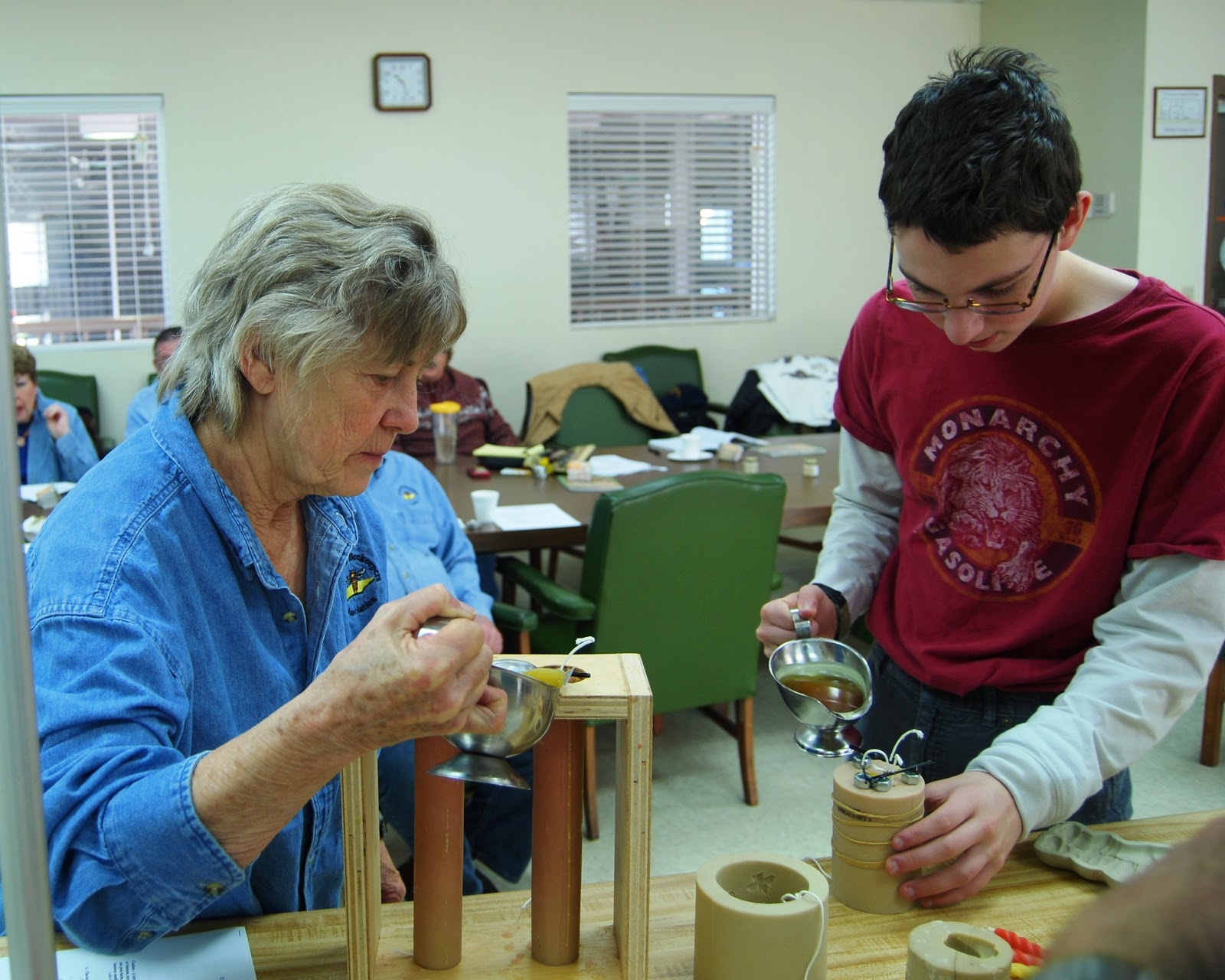
The text that the beekeepers use in the sessions on producing value-added bee hive products, Health and Healing with Bee Products by C. Leigh Broadhurst, also lists health benefits of honey. The author, a USDA research scientist, explains that honey is a broad-spectrum antibiotic; it is antifungal and antimicrobial; and it is sometimes mixed with propolis for wound treatments. Broadhurst also reveals that the vitamins, minerals, and enzymes present in honey aid in metabolism. The beekeepers also use beeswax to make candles and skin-care products. In today’s picture beekeepers pour beeswax into candle molds. The training sessions are funded by a grant from the Tennessee Department of Agriculture which recognizes the importance of increasing beekeeper income to ensure continued honey bee availability for crop pollination.
--Richard

Monday, December 5, 2011

Ultrafiltration of Honey


Honey bees use enzymes that they produce in their bodies to convert the sugars from the nectar of flowers into a concentrated, high-energy food that we know as honey. Along with sugars, honey contains enzymes and pollen from flowers growing in the area. That pollen can be used to identify the source of the honey. A recent report concerning the removal of pollen from honey brought considerable public discussion about the deliberate removal of pollen from honey by unscrupulous importers of foreign honey. The report by investigative journalist Andrew Schneider appeared in Food Safety News at http://www.foodsafetynews.com/2011/11/tests-show-most-store-honey-isnt-honey/. Schneider reported that independent testing of samples of honey found that three fourths of the honey on grocery store shelves could not even be called honey because pollen, a component of natural honey, had been removed. To hide the country of origin, some honey is highly processed by ultrafiltration to remove all pollen.

Responding to the discussion brought about by Schneider’s report, Dan Charles writes in NPR’s food blog, http://www.npr.org/blogs/thesalt/2011/11/25/142659547/relax-folks-it-really-is-honey-after-all?ps=cprs, in defense of honey on the grocery store shelf. Many in the public understand the deceptive practices of a few, but a number of citizens are confused about what real honey truly is. Many seek out a local beekeeper and purchase honey produced in their area. However, at almost every farmers market or honey sales event that we attend, we have individuals ask for sugar-free honey. Hearing that there is no such thing as a sugar-free honey, one lady exclaimed that she knew that there was because she had seen it on the grocery shelf. I assured her that the product did not come from a bee hive. Adulterated products are sometimes labeled to appear to be honey. Some contain high fructose corn sweetener and are labeled as “honey sauce.” Many processed food items boast on the label to contain honey while it is only a minor component. For information about honey, see the National Honey Board’s web site, http://www.honey.com/nhb/about-honey/. Enjoy real honey.
--Richard

Monday, November 7, 2011

Honey Contains Pollen

Honey is harvested as the bees make it, one drop at a time. To make a tablespoon of honey to pour over a hot buttered biscuit requires the full life’s work of 32 honey bees. Producing a jar of honey is the result of considerable effort by both the bees and their keeper. Unfortunately, there are those who take advantage of the appeal, reputation, and health benefits of honey to unscrupulously produce a lesser product and sell it as honey. They do this by adulterating the product by mixing in cheaper sweeteners or by altering the honey to hide its true origin.

In Andrew Schneider’s Food Safety News report, “Tests Show Most Store Honey Isn’t Honey: Ultra-filtering Removes Pollen, Hides Honey Origins,” the investigator writes that pollen is being removed from honey to hide whether the honey came from legitimate and safe sources. Honey is being produced in distant lands, shipped to intermediate countries, repackaged, and stripped of pollen to hide the true origin. According to Schneider, “Food scientists and honey specialists say pollen is the only foolproof fingerprint to a honey’s source.” Schneider explains that in the US the Food and Drug Administration says that a product that has been ultra-filtered and contains no pollen is not honey. One major honey packer describes ultra-filtration as “a deceptive, illegal, unethical practice.” Unfortunately, the FDA isn’t checking honey to see if it contains pollen. Food Safety News purchased honey and had it tested for pollen. They found that three fourths of honey purchased at groceries or big box stores and all honey purchased at drug stores contained no pollen. All honey purchased at farmers markets and “natural” stores, however, contained the expected pollen. Read this informative report at http://www.foodsafetynews.com/2011/11/tests-show-most-store-honey-isnt-honey/. In today’s photo, honey from late summer wildflowers and Arkansas Delta cotton flows in the Peace Bee Farm honey house. We appreciate those loyal customers who support the beekeeping tradition of producing real honey as the bees made it.
--Richard

Thursday, September 29, 2011

Robbing Behavior

A honey bee colony seeks out sources of carbohydrate to make honey anytime that conditions are acceptable for the bees to fly, and bees fly during daylight hours whenever the temperature is above 50 degrees Fahrenheit. Foraging worker bees collect most of their carbohydrate from flower nectar, a thin solution of sugar water. Bees also take unguarded honey from the hive of another bee colony that is too weak to protect its honey stores. This behavior is called “robbing.” For strong colonies, robbing is an efficient method of rapidly gaining additional honey stores, a definite survival strategy. Weak colonies are likely to starve after their honey stores are robbed out. This likely exerts selective pressure to remove weaker colonies or those prone to disease. Two honey bee colonies, even those sitting side-by-side in the same bee yard, do not share stored food resources. Every worker bee is a selfless contributor devoted to the care and protection of its own colony, but not to other colonies. While guard bees protect the hive from all intruders, their main duty involves protecting the colony from robbing by bees from other colonies. For the beekeeper, robbing is not a serious problem as long as there are numerous flowers in bloom. However, during times of dearth, like during the end of summer and early fall, robbing intensifies.

The harvesting of honey by humans has traditionally been called “robbing.” When bees are drawn to the smell of honey, harvesting becomes more difficult. If honey supers or frames of honey are left exposed in an opened hive or outside the hive, they readily induce robbing. The bees’ robbing tendency can be used by the beekeeper, as in today’s photo, to effectively clean honey supers after the harvest. Stack “wet” supers several hundred yards away from the bee yard, and bees will remove any traces of honey in a day’s time. To prevent robbing always reduce hive entrances whenever feeding, making colony divisions, and during the winter.
--Richard

Thursday, August 25, 2011

Summer Nectar Flow


A hot, dry summer is often the backdrop for a good honey production year. This year’s wet, stormy spring kept farmers out of the fields in the Arkansas Delta. Planting was delayed, but a healthy crop of cotton and soybeans followed. These crops account for an abundance of Delta honey. Honey bees gather significant amounts of nectar to make a surplus of honey in strong hives. A surplus of honey can only be produced if the colony is strong and productive, the hive is near a good source of nectar, and the queen is producing large numbers of eggs in the weeks prior to the major nectar flow. The timing of the colony’s population build-up is critical for honey production. If the colony is just starting to expand during the nectar flow, there will probably not be enough of the older worker bees, the foragers, to gather enough nectar to make a surplus of honey.

I tested using additional entrances to my stronger hives this year. The entrances are placed between surplus honey supers at the top of the hives. There is evidence that the entrances allow foragers to deliver their nectar more efficiently. Nectar is taken directly into the honey supers without having to be carried through the brood nest. Upper entrances also allow for extra ventilation at the top of the hive. However, the wooden shims used for the upper entrances violate the concept of bee space. Every opening inside a bee hive should be three eights of an inch. The shim’s wider gap between supers makes a space that the bees fill with honeycomb. In fact, many of the hives equipped with upper entrances became clogged with burr comb in the space between supers. Burr comb, which is any honeycomb that the bees build that does not conform to the shape and order of the hive’s removable frames, tends to break when the hive is opened for inspection or honey harvesting. Today’s picture: burr comb, a sticky mess.
--Richard