Showing posts with label University of Central Arkansas. Show all posts

Wednesday, October 9, 2019

UCA Entomology

I was honored to be invited to speak about bees and beekeeping to the entomology class at the University of Central Arkansas. We discussed the development of modern beekeeping from its early roots as a tradition of honey hunting. We looked at the evolution of bee hives from clay hives and woven skeps to hollow log “bee gums.” We observed the traditional tree-mounted cylindrical hives of Africa, the transitional Kenyan top bar hives, and finally the modern Langstroth hives. We also viewed the horizontal hives of eastern Europe and the vertical top bar hive, the Warre hive.

Following the classroom session, the students travelled to explore my nearby pollinator garden and bee hives. Pollinator gardens are any planting that provides flowering plants producing nectar and pollen. These gardens also include water, protective vegetative cover, and insect nesting spaces. Anyone planning a pollinator garden should restrict the use of pesticides. Flowering plants are chosen that bloom throughout the spring, summer, and fall. Bare ground provides nesting places for solitary bees, which largely nest underground. The entomology students collected insects from the pollinator garden, water garden, composters, and vitex trees. They observed orb spiders also gathering flying insects that ventured into their expansive webs. Students dug ant lion larvae from cone-shaped lairs in sandy soil. Compost barrels contained plenty of the efficient decomposers, black soldier fly larvae, and earwigs and various other insects were plentiful. Blue orchard bee nesting tubes showed evidence of usage by these and other native pollinators. Bare soil under oak trees revealed inch-wide holes where cicadas emerged as adults following years underground.

The students examined bee hives with colonies transitioning from summer to fall. Queen bees were laying eggs, and the students observed all stages of brood. Drones were few, as colony-wide reproduction by swarming has virtually ended for the year. Hives were heavy with ample stores of earthy fall honey. Today’s photo by UCA professor, Dr. David Dussourd: I examine bee hives with entomology students.
--Richard

Saturday, September 8, 2018

September Beekeeping

September brings changes for the bees. Summer flowers, yielding light colored and mild flavored honeys for the kitchen table, are replaced by fall flowers, producing robust flavored honeys, which beekeepers usually leave in the hives for the bees to consume over winter. Adrian Higgins describes how homeowners can plant flowering plants to provide a continuum of blooms providing nectar and pollen for honey bees throughout the spring, summer, and fall: https://www.arkansasonline.com/news/2018/sep/08/a-boon-to-bees-20180908/. As well as listing numerous species available for horticultural plantings, Higgins reminds us to provide bees water and avoid using pesticides. Another recent publication, About You Digital Magazine, http://aymag.com/all-the-buzz-arkansas-beekeepers-keep-hope-alive/, features Arkansas beekeeping friends, Jon Zawislak of the University of Arkansas Extension and John and Corinne Smith of Central Beekeepers Supply of Russellville, Arkansas. Apiary instructor, Jon Zawislak, explains the plight of honey bees that are stressed by parasites, pathogens, and loss of habitat. He explains that public awareness of the importance of honey bees in the production of our food has brought in many new beekeepers. John and Corinne Smith supply these beekeepers with bees, hives, and equipment at their Russellville business. John Smith explains the importance of bees, “Any non-wind-blown crop has to be pollinated by insects. And the honey bee is the world’s most efficient pollinator.” Zawislak is quite the promoter of Arkansas honey: “Fresh raw honey is so different and superior to what sits on most supermarket shelves that there is really no comparison. If you have ever eaten a true Arkansas homegrown tomato in the middle of the summer, you understand how different it is from those tough pink things labeled as a tomato in the supermarket in the winter. The difference in honey is like that.”

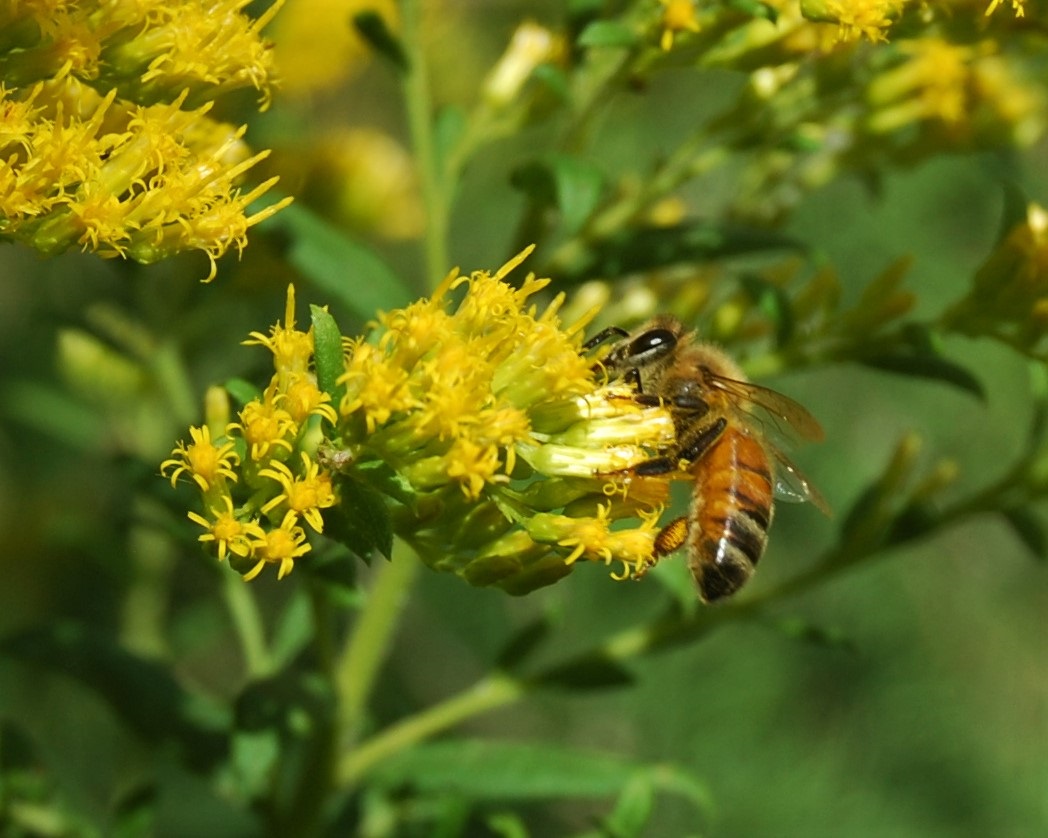
Elsewhere in Arkansas, a black bear was removed from the city of Conway near the University of Central Arkansas campus (UCA mascot is a bear). Several members of the Ozark Foothills Beekeepers Association, based in Conway, have experienced bears visiting their bee hives. Today’s photo: September goldenrod.
--Richard