Showing posts with label Jon Zawislak. Show all posts

Sunday, November 21, 2021

Congratulations, Jon Z!


Beekeepers across Arkansas and beyond our borders know Jon Zawislak (rhymes with Zah-Fish-Lock) simply as Jon Z. Now, we are delighted to announce that Jon has successfully defended his dissertation for a PhD in Entomology from the University of Arkansas. Jon, an Apiculture Instructor with the Cooperative Extension Service of the University of Arkansas Division of Agriculture is a valuable resource to beekeepers. An Eastern Apicultural Society Master Beekeeper himself, Jon often helps me analyze honey bee health issues. When I needed to respond to a beekeeper’s question about haplo-diploidy sex determination in bees, I called on Jon for an explanation (https://peacebeefarm.blogspot.com/2012/09/honey-bee-super-sisters.html). Jon trains many beekeepers, and he is a tremendous asset to the Arkansas Beekeepers Association. Jon serves as an ex officio member of the ABA’s Executive Committee, its webmaster, guest speaker recruiter, and himself a frequent presenter. Jon’s research looks into serious problems associated with honey bee health. He participated in measurements of the effects of neonicotinoid insecticides on honey bees. In one of his research projects Jon identified pathogens retarding the growth of the invasive honey bee pest, the small hive beetle. Jon found some of these potential biological control pathogens in the soil of my Arkansas bee yards. Jon conducted research into the foraging behavior of honey bees by attaching tiny labels onto bees and photographing their movements as they flew out and back into their hives.


Jon Zawislak is a recognized leader in his profession, and he encourages others to excel. He challenged one of his sons to make good grades in school, and he rewarded him with a sky-diving experience. Jon encouraged me to complete the EAS Master Beekeeper certification program, and he recruited me to teach beekeeping in Africa. Jon’s PhD program did receive an interruption when he donated a kidney. Such generosity! I am deeply proud of Dr. Jon Zawislak, shown here at an ABA conference with Dr. Jeff Harris and Audrey Sheridan of Mississippi State University and EAS Master Beekeeper, David Burns.

--Richard


Saturday, September 8, 2018

September Beekeeping

September brings changes for the bees. Summer flowers, yielding light colored and mild flavored honeys for the kitchen table, are replaced by fall flowers, producing robust flavored honeys, which beekeepers usually leave in the hives for the bees to consume over winter. Adrian Higgins describes how homeowners can plant flowering plants to provide a continuum of blooms providing nectar and pollen for honey bees throughout the spring, summer, and fall: https://www.arkansasonline.com/news/2018/sep/08/a-boon-to-bees-20180908/. As well as listing numerous species available for horticultural plantings, Higgins reminds us to provide bees water and avoid using pesticides. Another recent publication, About You Digital Magazine, http://aymag.com/all-the-buzz-arkansas-beekeepers-keep-hope-alive/, features Arkansas beekeeping friends, Jon Zawislak of the University of Arkansas Extension and John and Corinne Smith of Central Beekeepers Supply of Russellville, Arkansas. Apiary instructor, Jon Zawislak, explains the plight of honey bees that are stressed by parasites, pathogens, and loss of habitat. He explains that public awareness of the importance of honey bees in the production of our food has brought in many new beekeepers. John and Corinne Smith supply these beekeepers with bees, hives, and equipment at their Russellville business. John Smith explains the importance of bees, “Any non-wind-blown crop has to be pollinated by insects. And the honey bee is the world’s most efficient pollinator.” Zawislak is quite the promoter of Arkansas honey: “Fresh raw honey is so different and superior to what sits on most supermarket shelves that there is really no comparison. If you have ever eaten a true Arkansas homegrown tomato in the middle of the summer, you understand how different it is from those tough pink things labeled as a tomato in the supermarket in the winter. The difference in honey is like that.”

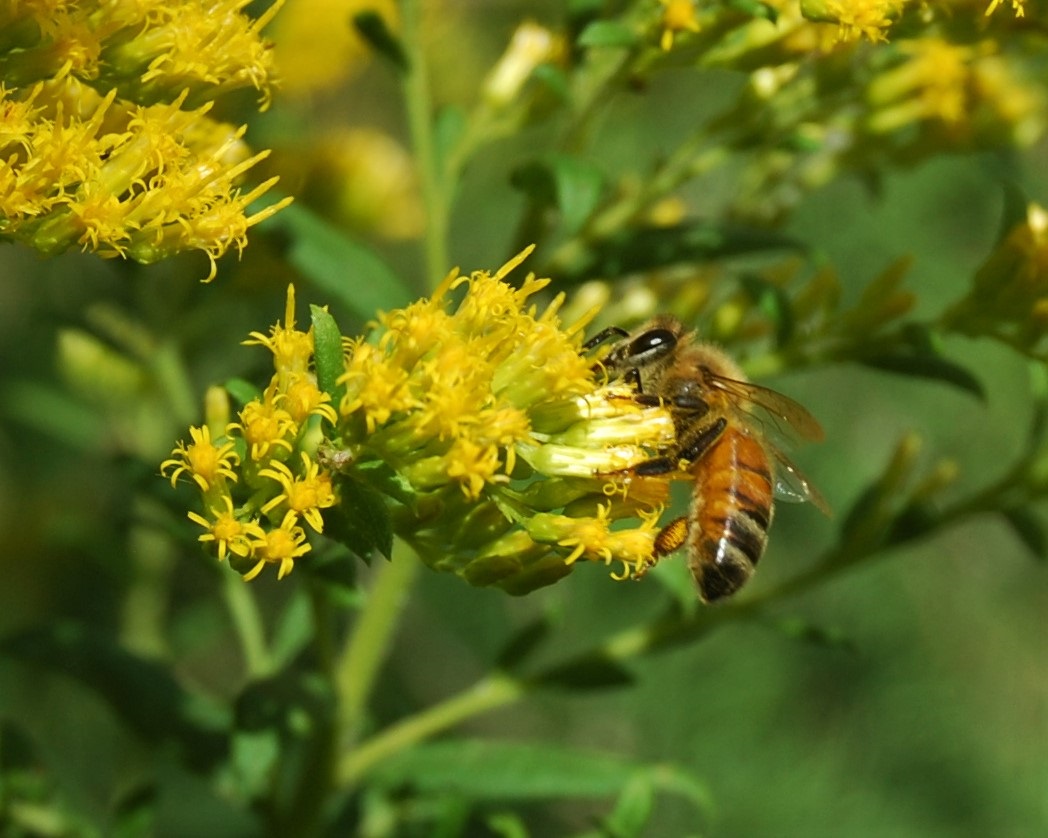
Elsewhere in Arkansas, a black bear was removed from the city of Conway near the University of Central Arkansas campus (UCA mascot is a bear). Several members of the Ozark Foothills Beekeepers Association, based in Conway, have experienced bears visiting their bee hives. Today’s photo: September goldenrod.
--Richard

Friday, August 17, 2018

Jon Zawislak


His name is Jon Zawislak; it rhymes with “Zah-FISH-Lock,” but everyone knows him simply as “Jon Z.” Jon’s known by beekeepers across the state of Arkansas and beyond for his engaging beekeeping training regularly accentuated with humor. Jon is an Eastern Apicultural Society Master Beekeeper and Arkansas’ State Extension Apiculturist. In this position, Jon trains beekeepers and conducts research on honey bee health issues. I have encountered numerous beekeeper students of Jon’s classes. They are enthusiastic, and they always feel like they are well-prepared by Jon’s instruction to start their beekeeping adventure. I have participated in some of his research. In one study, Jon searched for parasites that might be preying upon the invasive Small Hive Beetle. Sampling bees, combs, and soil surrounding the bee hives, Jon found on my farm and several other Arkansas sites a parasite attacking these pest beetles. The parasite has the potential of being a biological control of Small Hive Beetles, https://peacebeefarm.blogspot.com/2011/10/are-beetles-vulnerable.html. Jon also participated in a study of the effect of neonicotinoid insecticides on honey bees, https://peacebeefarm.blogspot.com/2015/02/neonics-questioned_12.html. While many wanted to blame the widely-used class of insecticides for causing excessive bee colony losses, Jon made measurements to get an accurate assessment of the effect of the insecticides. It now appears that the neonicotinoids are not the sole cause of the losses, but instead one of several contributing factors. Jon is always available to answer a technical question. When a reader of this blog questioned the mechanism for honey bees’ passing along genetic information, I asked Jon to explain for me, https://peacebeefarm.blogspot.com/2012/09/honey-bee-super-sisters.html. I am particularly grateful for Jon’s participation with the Arkansas Beekeepers Association as an active member of our leadership, https://peacebeefarm.blogspot.com/2015/11/bee-lining-in-ozarks.html.

Jon Zawislak received the prestigious 2018 Roger A. Morse Outstanding Teaching/Extension Service/Regulatory Award at the Eastern Apicultural Society’s conference at Hampton, Virginia. Dr. Morse developed the EAS Master Beekeeper program at Cornell University. Jon provided me the encouragement to complete my EAS Master Beekeeper certification. He is truly an inspiration. Congratulations, Jon Z.
--Richard