Saturday, July 31, 2010

An Anglo-Saxon Metrical Charm

The Anglo-Saxons formed the English nation. Kayla Miller, a senior at Rhodes College in Memphis, is studying Anglo-Saxon writings. After translating an eighth century piece, known as a metrical charm, she discovered the writing involved honey bee swarming. To provide some background information, she came out to the bee farm to visit, see some bee hives, and discuss honey bee swarming. Here is her translation of the 12-hundred-year-old piece, Against a Swarm:
Take dirt
Throw it over-head with your right hand
Throw it under-foot
Step on it with the right foot and say;
I seize it under-foot;
I found it.
Indeed. Earth has power
Against every creature,
And against hatred
And against enmity
And against the great tongue of man.
Cast earth over them
When they swarm and say:
Sit you victory women
Sink to the earth.
May you never wildly
To the woods fly!
Be as mindful of my welfare
As every man of food and property.

The language of English-speaking people has changed considerably over the past 12 hundred years; however I recognize some issues with dealing with honey bees and fellow people persist over hundreds of years. The act of throwing dirt over-head in the presence of swarming bees reminds me of the European custom known as tanging, involving clashing together pots and pans or ringing bells. The tradition of tanging persisted until recently. Many felt that the noise settled the swarming bees; actually tanging was dictated by an English king as a method of signaling to others that the noise-maker claimed ownership of the swarm of bees. Honey bees were especially valuable as a source of honey as a sweetener and beeswax for candle light. Every beekeeper that has gathered swarms knows the disappointment of having a swarm take flight and fly to the woods. The last sentence of the charm speaks of the value of the honey bee as food and property. In the picture, Kala visits Peace Bee Farm with the manuscript, Against a Swarm.
--Richard

Wednesday, July 28, 2010

One Queen at a Time

Queen mating nucleus hives reveal the workings of honey bee colonies on a small scale. These are the small bee hives where beekeepers raise queen bees. Mating nucleus hives are usually established by taking worker bees and brood from strong colonies and placing them in a box that holds less than the normal 10 frames. After remaining queen-less for about 24 hours, the bees in the nucleus hive develop a strong desire for a queen. When the beekeeper introduces a queen cell that holds a queen pupa almost ready to emerge into this queen-less hive, the bees readily accept it. The beekeeper counts the number of days that the queen develops in the queen cell and moves it to the mating nucleus hive one day before the queen emerges as an adult. Queen bees require 16 days to develop from egg to adult, and most colonies will accept any queen that emerges inside the hive.

Once the queen bee emerges, she begins searching for other queens in the hive. There may be other queens developing in the hive, and queen bees simply don’t allow competing queens to live in their hive. The first queen to emerge starts piping. Piping involves making a series of chirping and quacking sounds to call out to any other developing queens. Queen bees, still held in their own queen cells, respond to the piping. The emerged queen kills each of these potential competitors with her sting. In the photo, workers remove the dead queens from a pair of queen cells. They were killed by the first queen to emerge. If a queen successfully emerges from her cell, there will be a smooth, circular opening at the bottom; if the queen is killed inside its cell, a larger hole will be chewed in the side wall of the queen cell. After removing the dead queens, the workers chew down the queen cells. Without competition, a new colony is organized around the queen’s pheromones.
--Richard

Monday, July 26, 2010

Cotton in Bloom

Cotton is in bloom across the Arkansas Delta. Cotton, grown for fiber, is also an important source of nectar for the production of honey. Honey bees forage cotton on both its internal and external nectaries. Honey bees collect nectar secreted inside the pale yellow flowers on the first day of their bloom. After one day, the flowers change colors, becoming dark pink. The honey bees learn that the change of flower colors means they must move to the external nectaries. The honey bees then collect nectar from the green-colored bracts, leaf-like flower parts on the base of the flower. They also find nectar secreted from the under-side of the leaves. Cotton is a member of the mallow family which includes cultivated hibiscus plants, hollyhock, and okra. Swamp mallow, particularly attractive to bumble bees, is found along the banks of irrigation ditches and bodies of water.

Cotton produces large amounts of honey, which is light in color, flavor, and aroma. Cotton honey is a favorite of many who enjoy sampling honeys from various nectar sources. Some people detect cotton honey as subtly changing in flavor as it is held in one’s mouth. When the bees complete the process of curing honey, it contains about 82 percent sugar solids and 18 percent water. At this point, the bees seal the honey in the honeycomb cells with a capping of beeswax. With such a concentration of sugars, all honey forms crystals of sugar over time. Cotton honey, like most flower honeys, tends to crystallize fairly rapidly. Honeys derived from the flowers of trees tend to crystallize more slowly. We often select cotton honey to make creamed honey due to its pleasant flavor and tendency to readily crystallize and form a spreadable product. Creamed honey, often eaten on toast, biscuits, or pancakes, remains in a solid, spreadable form when refrigerated. Liquid honey is held at room temperature, not refrigerated. The formation of crystals does not damage the flavor or quality of honey.
--Richard

Friday, July 23, 2010

The Nectar Flow

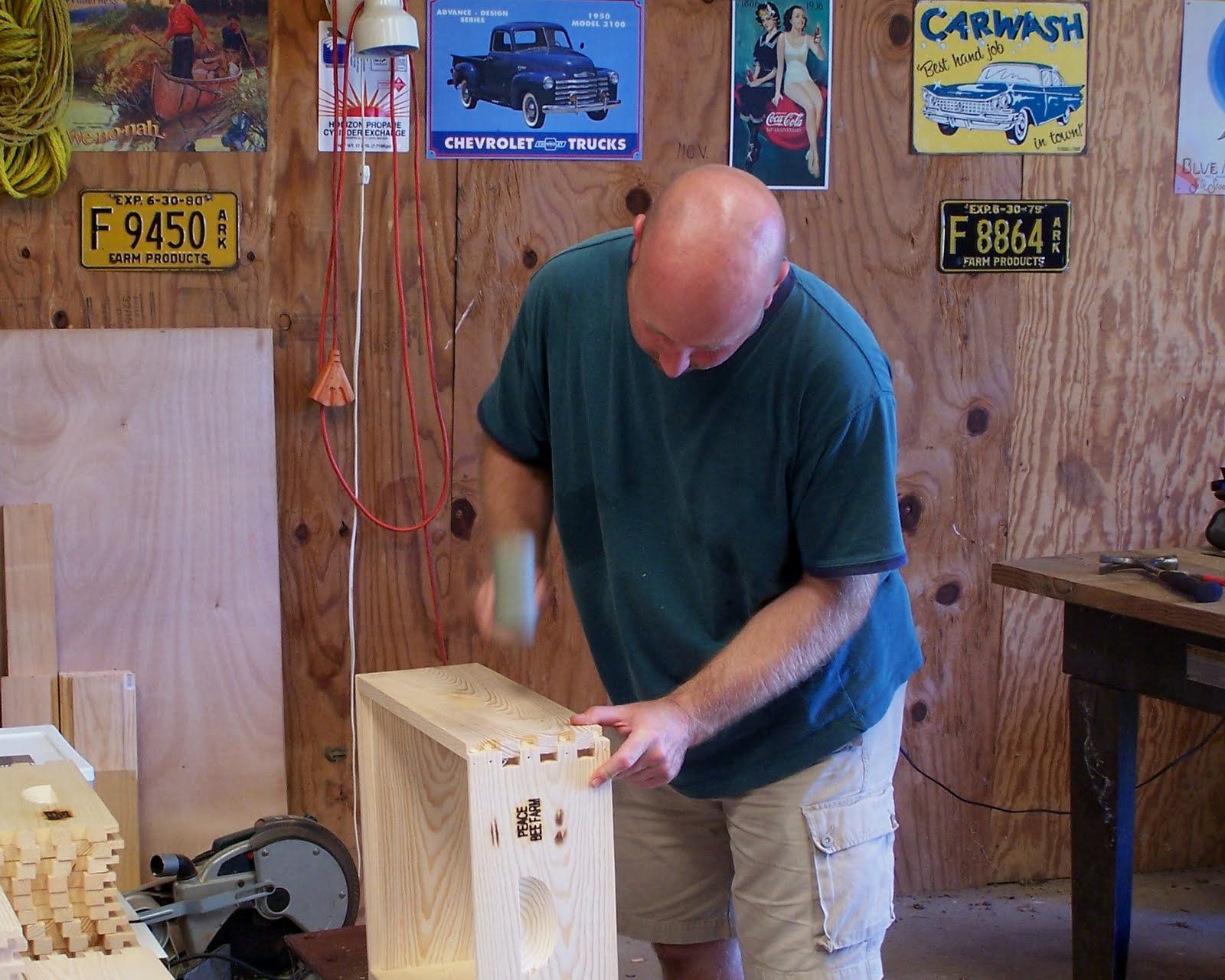
The honey bee hive is an orderly, humming operation during a strong nectar flow. Bees fly in and out of the hive at regular intervals. Foraging worker bees gather nectar any time that the flowering plants are secreting nectar and flying conditions are acceptable. When the foragers return to the hive, they pass off the nectar to house bees that move the nectar to available honeycomb cells where it is converted to honey. Much more storage capacity is required to hold the fresh nectar than is required to hold the finished honey. Large amounts of nectar are brought into the hive, but none of the bees seem to be in a hurry. The pace remains the same even though greater numbers of bees are working to accomplish their annual work of building honey stores to sustain the colony through the next winter. The pace of the work for the beekeeper, however, may not be as orderly. With an exceptionally strong nectar flow in progress, it is necessary to increase our efforts to provide honey storage capacity for the industrious bees. As a measure of caution, Tod and I head back to the wood shop to build some extra supers. This is a task that we prefer to do in cool weather, but we would rather perform some summer carpentry than risk missing an opportunity to collect honey. That’s Tod in the picture assembling the woodenware.

The colony never turns away nectar. If there are not enough honey supers in place, the bees will store the nectar in cells in the brood nest. This may result in the queen not having cells available to lay her eggs. This brood nest restriction is one of the major factors leading a colony to swarming. In the Arkansas Delta, the major nectar flows involve the agricultural crops, mainly soybeans and cotton. As the young worker bees evaporate the honey, it will be concentrated into a smaller volume in the honey supers.
--Richard

Thursday, July 22, 2010

A New Queen Emerges

Still wet, fuzzy, and pale in color, the new queen bee walked slowly and wobbly away from the queen cell on the thirteenth day after I placed the frame of young brood in the bee hive. She emerged from the bottom of the peanut-shaped emergency queen cell that the workers built around a one-day-old larva. The workers were desperate to produce a new queen, but they lacked a suitable larva to feed royal jelly to begin the physiological changes that make a larva develop into a queen rather than a worker. Their brood nest was filled with honey in all available cells. The hive contained no brood, and the colony appeared to be hopelessly queen-less. Without a new queen, the colony would die in about six weeks, the life expectancy of a worker bee.

 Over a hundred years ago, L. L. Langstroth wrote that we can save a failing colony of honey bees by bringing in a frame of very young brood from another hive. I chose a frame of mixed brood having all honey bee stages: eggs, larvae, pupae, and newly emerged adults. The young adult bees have highly developed glands to produce the food needed to feed the rapidly growing larvae. The pupae will be emerging soon to help boost the population of the colony. The youngest larvae and eggs are potential brood to be turned into a new queen. Click on the picture of the brood frame viewed from the bottom. The newly emerged queen is passing empty queen cells built along the lower edge of the frame. Queen cells always hang vertically, while drone and worker cells are oriented horizontally on the brood nest combs. The emergency queen cell that housed this queen during her development is to the right, in the middle of the frame. Workers thinned the beeswax from the lower end of the queen cell to assist her exit the cell. After a successful mating flight, the queen will continue the colony’s reproduction.
--Richard

Wednesday, July 21, 2010

4-H at 100 Years

Tod and I headed out for Martin, Tennessee, crossing the Mississippi River near Dyersburg. In the early morning light we spotted a peregrine falcon near the river. Beyond the river bluff we saw a bald eagle perched atop a dead tree high above an oxbow lake. Our destination was the 4-H Roundup being held at The University of Tennessee-Martin campus. For one hundred years the 4-H has been training young students in leadership and useful skills. The program teaches agricultural skills, but is expanding into areas not specific to the farm. In Tennessee 300 thousand students participate in 4-H projects. Tod and I were honored to participate in the 4-H Roundup, the competition among the state’s determined participants. We joined John Skinner of The University of Tennessee in judging presentations of the finalists among 17 hundred who participated in the entomology program. These students studied insects, learning how some are beneficial and some are pests. They studied insect control methods using biological controls as well as insecticides. Some in the entomology program are learning to manage honey bees.

The peregrine falcon and the bald eagle both are recovering in the South after their numbers were decimated as the result of the birds taking in persistent insecticides in their diets. Being at the top of the food chain, the birds received a concentrated amount of insecticides, including DDT. The chemicals were often absorbed from the soil by earthworms and passed along to birds and fish which were then eaten by the carnivorous falcons and eagles. The insecticides stopped the birds’ reproduction by making their egg shells thin and subject to breaking. In the photo, I am presenting awards on behalf of the Tennessee Beekeepers Association to the entomology program students at the 4-H awards banquet. A number of students received college scholarships for their efforts. I felt good after the day’s events, knowing that Tennessee is producing new generations of powerful birds of prey and agricultural leaders.
--Richard

Monday, July 19, 2010

Soybeans in Bloom

Soybeans are in bloom throughout the Arkansas Delta. The soybean is a member of the important family of bee plants, the legumes. The legumes are the bean or pea family. It includes a number of flowering plants which produce large amounts of nectar and pollen that is gathered by honey bees. The legume family includes both trees and smaller flowering plants. Among the trees are the Kentucky coffeetree, black locust, honey locust, redbud, and mimosa. Flowering plants, shrubs, and vines in the legume family include the peas and beans, peanuts, false indigo, vetch, clover, lespedeza, kudzu, and alfalfa. The legumes are important plants in agriculture and the throughout the environment because many of them enrich the soil by the action of nitrogen-fixing bacteria. These bacteria, found in nodules on the plant roots, take nitrogen from the atmosphere and convert it to a form useful for plant metabolism. The honey bees gather soybean nectar from the small, orchid-shaped flowers. Depending upon the variety of soybean plant, the flowers vary from white to pink. Today I found no honey bees foraging in a field of white-colored blooms. The bees were evidently drawn to another variety in a nearby field offering a stronger concentration of sugars as a greater reward to the bees. Soybean honey is light in color, flavor, and aroma.  

With the nectar flowing in the Delta, we crossed the Mississippi River today to harvest spring honey from our Tennessee hives. The honey bees are able to produce the most honey in years that are hot and dry. This year has proven to be just what is needed for a good yield. We collected heavy supers of spring wildflower and clover honey. One of our bee yards had been vandalized. Some individuals had thrown enough bricks at the hives to actually break the wooden hive bodies. Yes, I am sure that they received the desired effect. Defensive honey bees fly rapidly from their nest to repel attackers. They sting.
--Richard